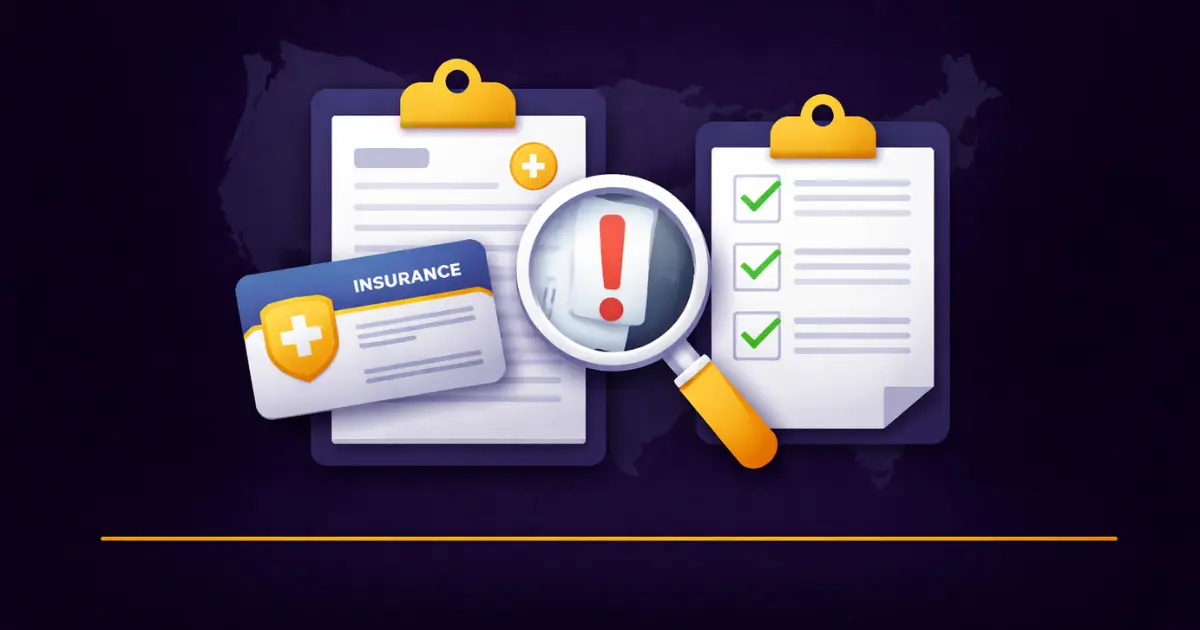
The Explanation of Benefits (EOB) arrived two weeks after surgery. Insurance had paid $8,400. The hospital was billing her $2,100 as the patient responsibility. But when she compared the EOB line by line to the hospital bill, three things did not add up.
First, there was a charge for anesthesia services that her insurance showed as covered at 100% — yet the hospital was billing her $400 for it. Second, there was a room charge for a third day she never spent at the hospital. Third, the procedure code for the surgery itself did not match what her surgeon told her the procedure was coded as.
Three errors. $900 in overcharges. She found them only because she compared documents side by side — something most patients never do.
In New Jersey, medical billing errors are extraordinarily common. Studies consistently show that more than 80% of medical bills contain at least one error. Most go unchallenged.
The Documents You Need Before You Can Dispute Anything
Itemized hospital bill. Not the summary bill — the itemized one that lists every charge line by line with the service date, description, and billing code. You are entitled to this under federal law and in most states. Request it in writing if the hospital does not provide it automatically.
Explanation of Benefits (EOB) from your insurer. This is the document your insurance company sends after processing a claim. It shows what the hospital charged, what the insurer paid, and what they determined your responsibility to be. The EOB is the benchmark against which you check the hospital bill.
Your insurance policy’s Summary of Benefits and Coverage (SBC). This tells you what your plan covers, at what percentage, and what your deductible and out-of-pocket maximum are. You need this to verify that the EOB applied your benefits correctly.
Medical records for the visit. If you are disputing whether a service was performed, your medical records are your evidence. You are entitled to your records under HIPAA. Request them from the hospital’s medical records department.
Step-by-Step Dispute Process — Hospital Bill After Insurance
Step 1 — Request the itemized bill
Call or write to the hospital billing department and request a complete itemized bill. Specify in writing that you are requesting an itemized statement, not a summary. Most hospitals provide this within 5 to 10 business days. If they delay or refuse, reference your state rights — in most states you are legally entitled to this document.
Step 2 — Compare EOB to itemized bill line by line
Place both documents side by side. For every charge on the hospital bill, find the corresponding line on your EOB. Note any discrepancy in amount, any charge the EOB does not address, and any service shown on the EOB that is not on the itemized bill. Write down each discrepancy with the specific dollar amounts involved.
Step 3 — Dispute billing errors directly with the hospital
Call the hospital billing department. Document the call — date, time, representative name, reference number. For each error, state the specific discrepancy: “Your bill shows $400 for anesthesia on line 7. My EOB shows this was covered at 100% with no patient responsibility. Please correct this charge.” Follow up the call in writing via email or certified mail within 48 hours summarizing what was discussed and what corrections you requested.
Step 4 — Dispute with your insurance company if the EOB is wrong
If the error is in how your insurance company processed the claim — wrong coverage percentage applied, deductible incorrectly calculated, claim processed as out-of-network when provider was in-network — file a formal appeal with your insurer. Under the ACA, insurers must have an internal appeal process and must respond within specific timeframes. Get the appeal in writing.
Step 5 — File a complaint with your state insurance department
If your insurer denies your appeal and you believe they applied your benefits incorrectly, file a complaint with your state insurance department. Every state has an insurance commissioner’s office that investigates consumer complaints. This step is free, takes 15 minutes online, and gives your complaint official standing.
Step 6 — Request an external review
Under the ACA, if your insurer denies your internal appeal, you have the right to an independent external review by a third party not affiliated with your insurer. The external reviewer’s decision is binding on the insurance company. This is the most powerful single tool available in insurance disputes — and most people never use it.
Most Common Medical Billing Errors to Look For
| Error Type | What It Looks Like + How to Catch It |
|---|---|
| Duplicate charges | Same service billed twice on different dates or same date. Compare every line for duplicate service descriptions or codes. Common in multi-day hospital stays. |
| Upcoding | A less expensive service is billed under a more expensive procedure code. Requires comparing the billing code to your medical records description of what was actually done. |
| Unbundling | Services that should be billed as a single bundled code are split into multiple separate charges — inflating the total. Common in surgical billing. A surgeon who bundles procedures improperly can generate thousands in unnecessary charges. |
| Services not rendered | Charges for consultations, therapies, or tests that never happened. Your medical records should show no documentation of the service. Compare billing to clinical notes line by line. |
| Wrong patient room type | Billed for a private room when you were in a shared room, or for ICU when you were in a standard room. Check against your actual room assignment in medical records. |
| Operating room time errors | OR time billed by the minute in many hospitals — inflated times are common. Ask for the actual surgical time documented in the anesthesia or surgical report. |
| Incorrect insurance processing | Provider treated as out-of-network when they were in-network, wrong deductible amount applied, wrong copay percentage applied. Compare EOB to your policy SBC carefully. |
| Balance billing (when prohibited) | Out-of-network provider bills you for the difference between their rate and what your insurer paid — when federal or state law prohibits this. See the No Surprises Act section in our surprise billing article. |
What Actually Happened to Grace in Ohio
Grace had knee replacement surgery at a Cleveland hospital. Her insurance processed the claim. She received a bill for $3,200 as her patient responsibility after the insurance payment.
She requested an itemized bill. Reviewing it took her two evenings. She found four errors: a $480 duplicate physical therapy charge, a $210 charge for a specialist consultation that never took place, $320 in operating room time that exceeded the documented surgical time in the anesthesia report by 40 minutes, and a $190 discrepancy in how her deductible was applied versus her EOB.
Total overcharges: $1,200. She sent a written dispute letter to the hospital billing department citing each error with the specific supporting document. Three of the four corrections were made within two weeks. The fourth — the deductible discrepancy — required a call to her insurer who reprocessed the claim. Her actual balance was $2,000.
Ohio does not have a state-specific medical billing dispute law beyond federal requirements. But federal rights — the right to an itemized bill, the right to an EOB, the right to an internal and external appeal — were enough to recover $1,200 she should not have been charged.
State Insurance Department Contacts for Billing Disputes
| State | Insurance Department | File Complaint At |
|---|---|---|
| Alabama | AL Dept of Insurance | aldoi.gov |
| Alaska | AK Division of Insurance | commerce.alaska.gov/ins |
| Arizona | AZ Dept of Insurance | insurance.az.gov |
| Arkansas | AR Insurance Dept | insurance.arkansas.gov |
| California | CA Dept of Insurance | insurance.ca.gov |
| Colorado | CO Division of Insurance | doi.colorado.gov |
| Connecticut | CT Insurance Dept | portal.ct.gov/CID |
| Delaware | DE Dept of Insurance | insurance.delaware.gov |
| Florida | FL Office of Insurance Regulation | floir.com |
| Georgia | GA Office of Insurance | oci.georgia.gov |
| Hawaii | HI Insurance Division | cca.hawaii.gov/ins |
| Idaho | ID Dept of Insurance | doi.idaho.gov |
| Illinois | IL Dept of Insurance | insurance.illinois.gov |
| Indiana | IN Dept of Insurance | in.gov/idoi |
| Iowa | IA Insurance Division | iid.iowa.gov |
| Kansas | KS Insurance Dept | insurance.ks.gov |
| Kentucky | KY Dept of Insurance | insurance.ky.gov |
| Louisiana | LA Dept of Insurance | ldi.la.gov |
| Maine | ME Bureau of Insurance | maine.gov/pfr/insurance |
| Maryland | MD Insurance Administration | insurance.maryland.gov |
| Massachusetts | MA Division of Insurance | mass.gov/orgs/division-of-insurance |
| Michigan | MI Dept of Insurance | michigan.gov/difs |
| Minnesota | MN Dept of Commerce | mn.gov/commerce |
| Mississippi | MS Insurance Dept | mid.ms.gov |
| Missouri | MO Dept of Insurance | insurance.mo.gov |
| Montana | MT Commissioner of Securities and Insurance | csimt.gov |
| Nebraska | NE Dept of Insurance | doi.nebraska.gov |
| Nevada | NV Division of Insurance | doi.nv.gov |
| New Hampshire | NH Insurance Dept | insurance.nh.gov |
| New Jersey | NJ Dept of Banking and Insurance | nj.gov/dobi |
| New Mexico | NM Office of Superintendent of Insurance | osi.state.nm.us |
| New York | NY Dept of Financial Services | dfs.ny.gov |
| North Carolina | NC Dept of Insurance | ncdoi.com |
| North Dakota | ND Insurance Dept | insurance.nd.gov |
| Ohio | OH Dept of Insurance | insurance.ohio.gov |
| Oklahoma | OK Insurance Dept | oid.ok.gov |
| Oregon | OR Insurance Division | dfr.oregon.gov |
| Pennsylvania | PA Insurance Dept | insurance.pa.gov |
| Rhode Island | RI Insurance Dept | dbr.ri.gov |
| South Carolina | SC Dept of Insurance | doi.sc.gov |
| South Dakota | SD Division of Insurance | dlr.sd.gov/insurance |
| Tennessee | TN Dept of Commerce and Insurance | tn.gov/commerce |
| Texas | TX Dept of Insurance | tdi.texas.gov |
| Utah | UT Insurance Dept | insurance.utah.gov |
| Vermont | VT Dept of Financial Regulation | dfr.vermont.gov |
| Virginia | VA Bureau of Insurance | scc.virginia.gov/pages/Insurance-Information |
| Washington | WA Office of Insurance Commissioner | insurance.wa.gov |
| West Virginia | WV Offices of Insurance Commissioner | wvinsurance.gov |
| Wisconsin | WI Office of Commissioner of Insurance | oci.wi.gov |
| Wyoming | WY Insurance Dept | doi.wyo.gov |
Questions People Ask About Disputing Medical Bills After Insurance
How long do I have to dispute a medical bill?
Most hospitals allow disputes for 30 to 180 days after billing. Your insurer’s internal appeal deadline is typically 180 days from the date of the adverse decision. External review must usually be requested within 4 months of the internal appeal denial. Do not wait — the earlier you dispute, the more options you have.
What if the hospital refuses to correct a billing error?
Escalate in writing. Request the name and contact of the hospital’s patient advocate or billing compliance officer. File a complaint with your state’s hospital licensing authority and your state insurance department if the error involves insurance processing. If the amount is significant, consult a medical billing advocate or healthcare attorney.
Can I get a professional to dispute the bill for me?
Yes — medical billing advocates are professionals who review and dispute medical bills on your behalf. They typically charge a percentage of what they save you — ranging from 25 to 35 percent of the reduction. For complex bills with large errors, a billing advocate often pays for itself significantly.
What is the difference between an internal appeal and an external review?
An internal appeal is reviewed by your own insurance company. They are reviewing their own decision — which creates an obvious conflict of interest but is required as a first step. An external review is conducted by an independent organization certified by your state that has no financial relationship with your insurer. External reviews are binding — if they rule in your favor, the insurer must pay. This is why external review is so powerful and why so few people know to use it.
Centers for Medicare and Medicaid Services (CMS) ·
Healthcare.gov — How to Appeal a Health Insurance Decision ·
Consumer Financial Protection Bureau (CFPB) ·
State Insurance Department Official Websites
📋 Disclaimer: The information on this page is for general educational purposes only and does not constitute legal or financial advice. Medical billing and insurance dispute processes vary by state and insurer and change regularly. The information here reflects our research as of early 2026. Always verify current dispute procedures with your insurer and state insurance department. USARoundup.com is not a law firm and does not provide legal representation of any kind.
Last reviewed and updated for 2026 · USARoundup.com