The attorney who finally took David’s case said the same thing she says to almost everyone: “You should have been documenting from day one.” David had let six months pass before writing anything down. He remembered the adjuster’s excuses — but he could not prove them.
The insurer’s file was organized, dated, and self-serving. David’s recollection was detailed but unverifiable. Cases like his are won and lost before the first attorney meeting — in the months when the claimant is still hoping the insurer will do the right thing.
In New Jersey I have watched strong bad faith cases fail because the claimant had no documentation, and watched weak bad faith cases succeed because the claimant had kept a meticulous record. Documentation is not just helpful — it is often the difference between a settlement and a dismissal.
Start Your Documentation File the Day the Claim Is Filed
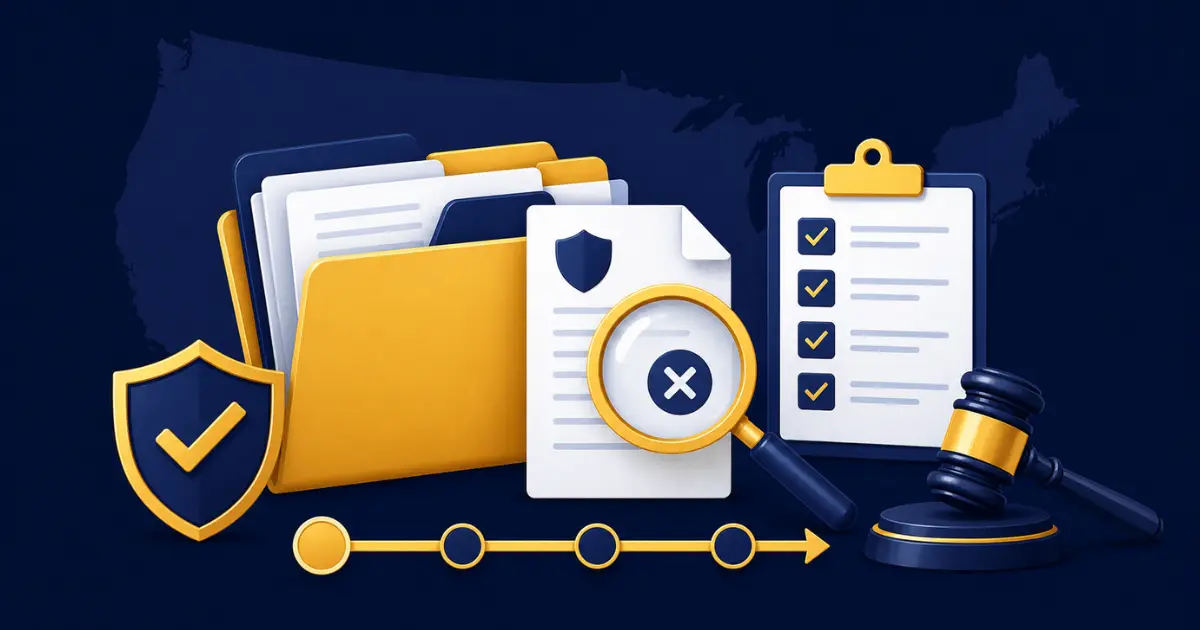
Create a dedicated folder — physical and digital — for this claim. Every document goes in it. Every email gets saved. Every phone call gets a written summary within 24 hours. Date everything. This is not paranoia — it is the only way to build a case if you later need one.
The 10 Categories of Evidence That Build a Bad Faith Case
1. The Complete Claim Timeline
Write a chronological log of every event in your claim — date filed, date acknowledged, every communication, every request, every response, every deadline. This timeline becomes your attorney’s roadmap and your primary exhibit. Include the insurer’s statutory deadlines from your state’s prompt payment laws and mark each one as met or missed.
2. Every Denial Letter — Word for Word
Preserve every denial letter in original form. Do not just read it and file it — annotate it. For each stated reason for denial, document the specific evidence that contradicts it. If they denied for “lack of documentation” and you had submitted the documentation three weeks earlier, that contradiction is bad faith evidence.
3. Call Logs With Adjuster Names and Reference Numbers
After every phone call with the insurance company: write down the date, time, name of the person you spoke with, their direct number or extension, the claim reference number they gave, and a summary of exactly what was said — including any promises, excuses, or reasons given. Send a follow-up email within 24 hours summarizing the call. “Per our conversation today, you confirmed X” — this creates a written record the insurer cannot easily dispute.
4. Proof of Every Document You Submitted
Every document you send to the insurer — medical records, repair estimates, proof of loss, W-2s, anything — should be sent certified mail with return receipt or by email with read receipt. Keep a log of what was sent, when, and how. When the insurer later says they never received it or need it again, your delivery confirmation is evidence of their bad faith.
5. The Insurer’s Own Claim File
Once you hire an attorney, they will request the insurer’s complete claim file through discovery. This file contains the adjuster’s internal notes, communications between the adjuster and supervisors, instructions from management, and the reasoning behind decisions. Internal notes saying “hold payment until we see if they give up” or “deny and see if they appeal” are some of the most powerful bad faith evidence that exists. You cannot get this file before litigation — but preserve everything to make the eventual comparison between their file and yours as clear as possible.
6. Expert Opinions That Contradict the Insurer’s Reviewer
If the insurer denied your claim based on a medical reviewer, independent adjuster, or expert who contradicted your own evidence — get your own expert’s written opinion. A treating physician’s letter directly addressing and contradicting the insurer’s reviewer’s conclusions is critical evidence. For property claims, an independent adjuster’s estimate that significantly exceeds the insurer’s is powerful documentation of unreasonable claim valuation.
7. Financial Harm Documentation
Document every financial consequence of the delay. Missed mortgage payments — statement showing the arrears. Medical bills you paid out of pocket while waiting for insurance to cover them — receipts. Credit score drops from unpaid bills caused by the delay — credit reports with dates. Business losses — financial statements. These documents prove consequential damages and support emotional distress claims by showing concrete financial harm.
8. Medical Documentation of Emotional Distress
If the insurer’s conduct has affected your mental health — and prolonged unjust denial often does — document it medically. See your doctor or a mental health professional. Describe the situation and its impact. Therapy notes, psychiatric evaluations, and physician records connecting your anxiety or depression to the insurance dispute are necessary to recover emotional distress damages. Self-reported distress without medical documentation carries far less weight.
9. The Policy Itself — Every Page
Get the complete insurance policy including all endorsements, riders, and amendments. Read every exclusion the insurer cited. For each exclusion, document whether it actually applies to your facts. Many bad faith cases succeed because the insurer cited an exclusion that, when the policy language is read carefully, does not apply to the claimant’s situation. Your attorney needs the complete policy.
10. The Insurer’s Communications With Your State Insurance Department
If you filed a complaint with your state insurance department, request a copy of the department’s correspondence with the insurer through a public records request. The insurer’s written explanations to the regulator — sometimes different from what they told you — can be powerful evidence. The department’s findings, even if they did not result in enforcement action, document the regulatory assessment of the insurer’s conduct.
The Documentation Checklist
| Document / Evidence | Priority | What to Preserve and How |
|---|---|---|
| Original insurance policy + all riders | Critical | Full copy including declarations page and all endorsements. Request from insurer in writing if you do not have it. |
| Initial claim filing confirmation | Critical | Claim number, date filed, confirmation email or letter. Screenshot if filed online. |
| All denial letters | Critical | Save originals. Scan and save digitally. Note every reason cited. |
| Adjuster call log | Critical | Date, time, name, reference number, summary of conversation, follow-up email sent. |
| All documents submitted + proof of delivery | Critical | Certified mail receipts or email read receipts for every submission. |
| State prompt payment deadlines | High | Look up your state’s claim acknowledgment, investigation, and payment deadlines. Log whether each was met. |
| Medical records supporting claim | High | Treating physician records. Specialist reports. Test results. Any document supporting the claim’s validity. |
| Independent expert opinions | High | Written opinions from your own medical, repair, or valuation experts contradicting the insurer’s reviewers. |
| Financial harm records | High | Bank statements, mortgage statements, medical bills paid OOP, credit reports — all dated. |
| Mental health treatment records | High | Therapy notes, physician records documenting anxiety/depression connected to the insurance dispute. |
| State insurance department complaint + response | Medium | File number, your complaint, insurer’s response, department findings. |
| Any settlement offers made and refused | Medium | Written record of every offer amount, date, and your response. Shows insurer’s valuation of the claim. |
| Emails from insurer employees | Medium | Save all — do not delete even seemingly routine correspondence. Tone and language matter in bad faith cases. |
| Social media posts by insurer | Low | Screenshots of any insurer communications on social platforms regarding your claim or similar claims. |
What Actually Happened to David in Ohio
David had homeowner’s insurance on a property damaged by a burst pipe. The damage was clear — $47,000 in repair estimates from two independent contractors. The insurer’s adjuster assessed $12,000. For seven months the insurer requested duplicate documentation, changed adjusters twice, and offered incremental increases that never came close to the actual repair cost.
When David finally hired an attorney, he had saved every email, every letter, and had sent follow-up emails after every phone call. His call log showed five promises of “a decision within two weeks” — none of which were kept. His delivery confirmations showed that every requested document had been submitted, many of them twice.
His attorney compared David’s timeline to Ohio’s prompt payment statute deadlines. The insurer had missed four separate statutory deadlines. That alone established the legal foundation for a bad faith claim before the attorney had even analyzed the merits of the underlying dispute.
The case settled before trial for $163,000 — more than three times the original repair estimate — plus attorney fees. David’s documentation made that result possible. The attorney said he had never seen a client arrive with a more complete file.
Questions People Ask About Documenting Insurance Bad Faith
Can I record my phone calls with the insurance company?
It depends on your state. One-party consent states — including most US states — allow you to record a call you are participating in without telling the other party. Two-party consent states — including California, Florida, Illinois, Maryland, Massachusetts, Nevada, New Hampshire, Oregon, Pennsylvania, and Washington — require all parties to consent. In two-party states, recording without consent may be illegal and the recording may be inadmissible. Look up your state’s recording consent law before recording any calls.
What if I did not document early — is my case ruined?
Not necessarily. Start documenting now. Going forward, a complete record from today helps even if early events are undocumented. Your attorney can use the insurer’s own claim file — obtained through discovery — to reconstruct the history. Internal insurer documents sometimes document bad faith conduct better than anything the claimant could have preserved.
How do I get the insurer’s internal claim notes?
Through litigation discovery — specifically, document requests served after a lawsuit is filed. The insurer must produce their complete claim file including internal notes, supervisor communications, and any reserve evaluations. This is one of the most important reasons to file suit when bad faith is suspected — the insurer’s own file often provides the clearest evidence of bad faith conduct.
Should I send a preservation letter to the insurer?
Yes — once you suspect bad faith, your attorney should send a litigation hold or preservation letter demanding the insurer preserve all documents, emails, notes, and electronic records related to your claim. Destroying records after receiving a preservation letter can itself constitute spoliation — potentially an independent ground for sanctions and adverse inferences at trial.
What if the insurer asks me to sign forms allowing them to get my records directly?
Be careful. Blanket authorizations allowing insurers to access your medical, financial, or employment records without limitation are worth scrutinizing with an attorney. You have the right to review what records are being requested and to limit authorizations to records relevant to your claim. An overly broad authorization is often a sign that the insurer is looking for reasons to deny rather than reasons to pay.
National Association of Insurance Commissioners (NAIC) ·
U.S. Department of Labor ·
State Insurance Department Official Websites · State Prompt Payment Statutes
📋 Disclaimer: The information on this page is for general educational purposes only and does not constitute legal advice. Documentation requirements and bad faith standards vary by state. The information here reflects our research as of early 2026. Always consult a licensed bad faith insurance attorney before taking legal action. USARoundup.com is not a law firm and does not provide legal representation of any kind.
Last reviewed and updated for 2026 · USARoundup.com